
Small model, careful pipeline
An autoresearch method for closing the gap to frontier LLMs on long, multi-document summarisation. Tested on pre-session briefs built from the transcripts of two synthetic patients.
A cheap model can get close, if it does less
Frontier language models summarise long, multi-document material well, but running one before every output gets expensive. Small models are cheap, but they lose information over long inputs. We asked how far a low-cost model can go when it sits inside a carefully engineered pipeline and is improved by an automated loop that evaluates every change with other models, with no human raters.
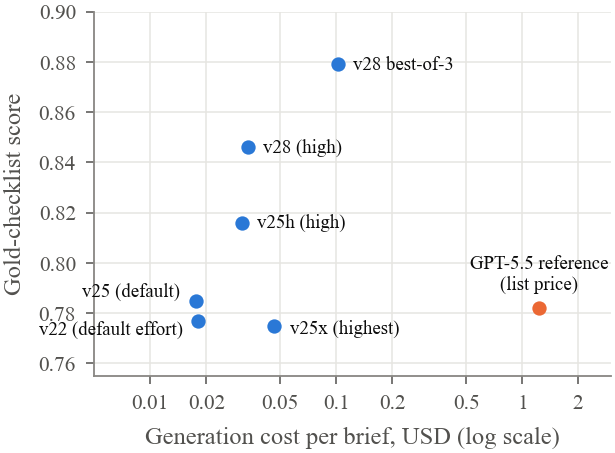
Over 30 versions and 16 blind review rounds, the small model rose from 0.647 to 0.846 on a weighted gold checklist (0.879 when the best of three runs is picked by a reference-free verifier). The frontier reference scored 0.782. In blind review by an LLM supervisor the two could not be told apart at this sample size: the mean paired difference was +0.05 (SD 0.49). The same, unchanged reference brief received between 3.50 and 4.03 from that supervisor across 13 rounds, so the judge's own noise turned out to be a finding in its own right.
Contents
Long input, fixed structure, routine use
Many practical summarisation tasks share three properties: the input is long and spread across many documents, the output follows a fixed structure with counts, dates and verbatim evidence, and the output is produced routinely, so cost matters.
We used one such task as a testbed: a structured brief that a CBT therapist can read in about three minutes before a session. It lists core beliefs with session counts, rules, recurring distortions, typical ABC episodes, tested predictions, the last session and points the therapist may want to bring to today's session. By session 20 the material is around 130,000 words.
The task suits a methods question because it has a known structure (Beck's cognitive model), a natural notion of verifiable evidence (the patient's verbatim words) and several traps: a belief that was first worded by the therapist, or a metaphor that is not a statement about death.
Two synthetic patients
Both patients were generated with our layered synthetic-patient method (profile sheet, therapeutic arc, session plan and voice guide first, then sessions generated one by one as ASR-style transcripts). Anita: 20 sessions, 131,498 words, J. Beck-style CBT. Markus: 12 sessions, 83,978 words, with a therapist who works partly in schema therapy, so the brief has to translate the material back into CBT terms. For each patient a gold reference was written independently from a full reading of the transcripts. No real patient data were used.
Division of labour
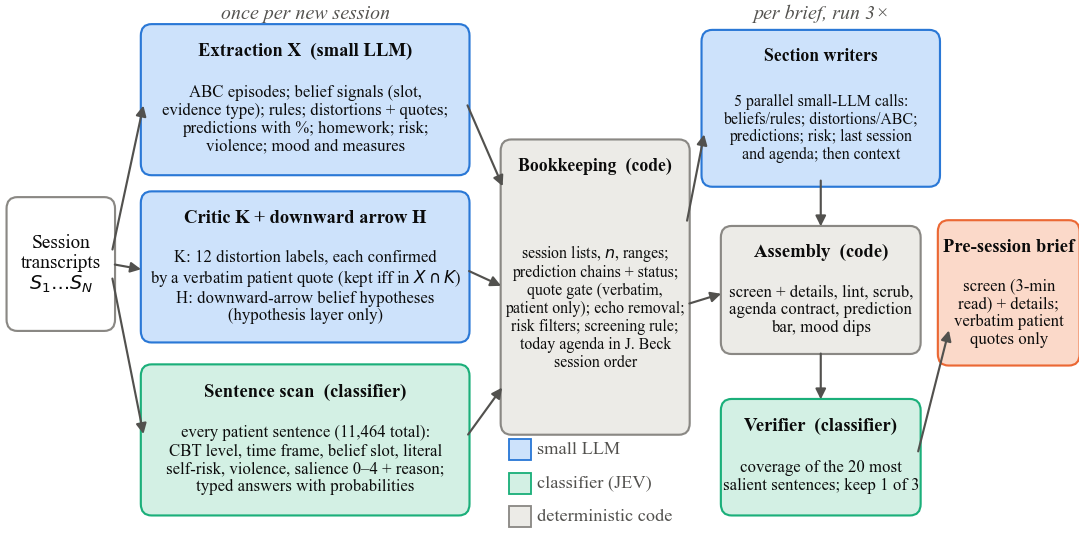
The decisive changes were not better prompts but a reassignment of responsibilities. Each component does only what it is good at.
Deterministic code
Everything that can be counted, ordered or checked
Session lists, counts and ranges for each belief; prediction chains linked across sessions; a verbatim-quote gate that drops any quote not found in the patient's own lines; removal of therapist echoes; and, from version 28, the order of the suggested points for today's session. Once a defect in this code is found, it stays fixed.
A sentence classifier
Judgments that need no text generation
Every patient sentence (11,464 in total) is labelled once: CBT level (automatic thought, rule, belief, emotion, behaviour…), time frame (now or recalled), literal or figurative wording, and how salient the sentence may be for the next session, each with a probability. The same classifier later serves as a reference-free verifier and as the checklist grader.
A small language model
Short writing from prepared material
Per session, the small model extracts structure, confirms distortions with verbatim quotes and proposes hypotheses (stored as hypotheses, never as evidence). Per brief, five section writers run in parallel, each seeing only the session-numbered data for its own section and instructed never to invent session numbers or quotes.
Best of three, without looking at the answer
Run-to-run differences within one version were often larger than differences between versions. So the brief-level pipeline runs three times, and a verifier picks one: it takes the 20 most salient patient sentences and asks the classifier whether each is reflected in the brief. The verifier never sees the gold reference or the checklist.
The autoresearch loop
An automated development loop in the spirit of recent automated-experimentation work: propose one change, run it, keep it only if two independent metrics agree.
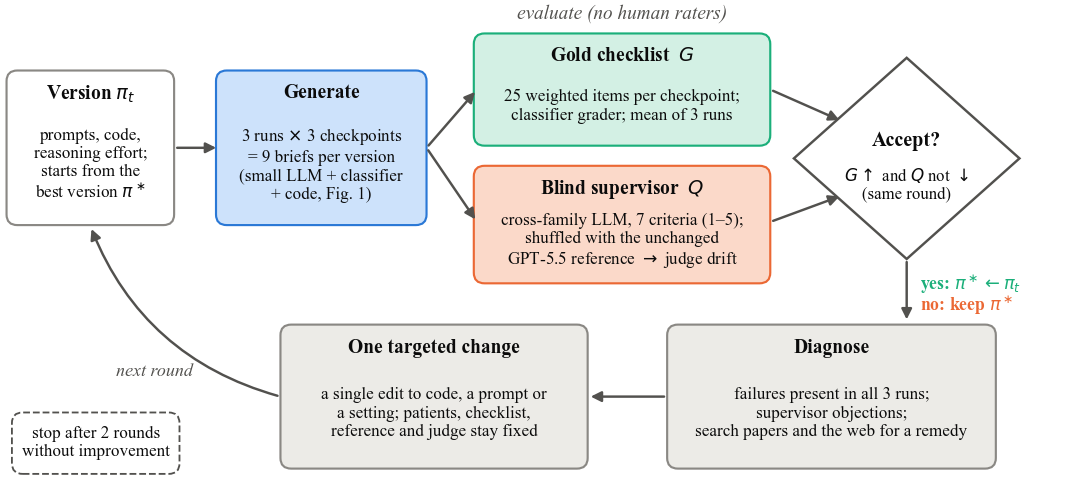
- Two metrics. A gold checklist of 25 weighted statements per checkpoint, graded by the classifier, and a blind review by an LLM supervisor from a different model family, scoring seven criteria on a 1–5 scale.
- A fixed anchor. The supervisor always also sees one unchanged frontier reference brief, under a random letter, so the judge's own drift is measured in every round.
- One change at a time. Failures present in all three runs and the supervisor's objections drive one targeted change per round, informed by a literature search.
- A fixed stop rule. Two consecutive rounds without improvement end the loop. It stopped at v28.
- A fixed cost ceiling. No model more expensive than the small model or the classifier may be used inside the pipeline.
What we observed
Descriptive statistics on three checkpoints (Anita before sessions 13 and 20, Markus before session 12) and three runs per version.
Content coverage: the gold checklist
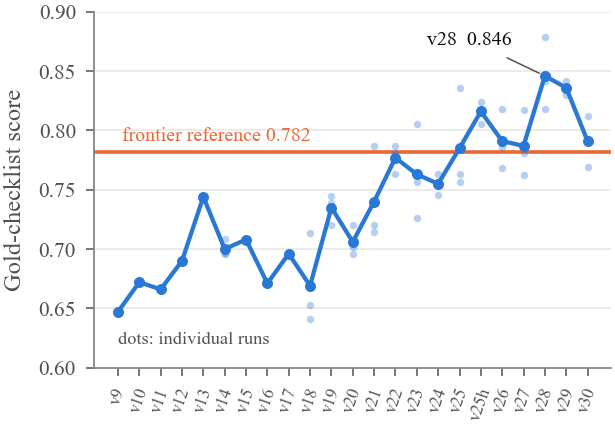
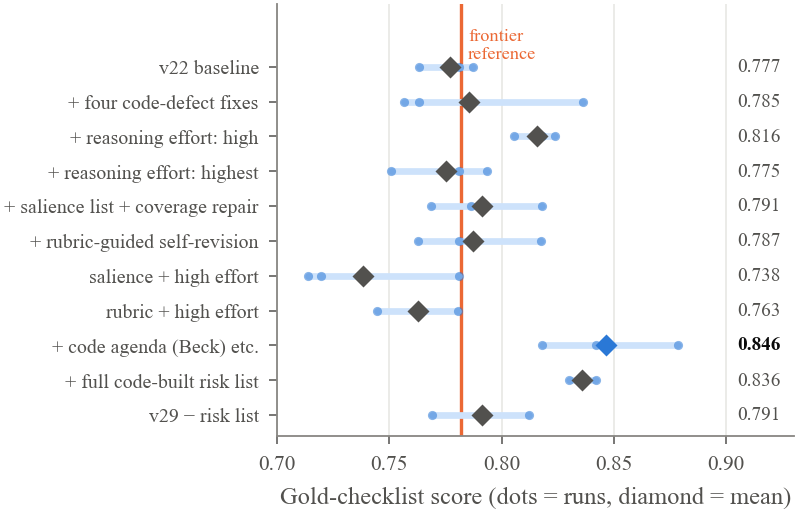
The small model started well below the reference (0.647 vs 0.782), crossed it at v25 and reached 0.846 at v28. All three v28 runs (0.818, 0.842, 0.879) lie above the reference. Two later versions did not improve on v28, and the loop stopped.
| Anita, before S13 | Anita, before S20 | Markus, before S12 | |
|---|---|---|---|
| v28, mean of 3 runs | 0.963 | 0.800 | 0.776 |
| v28, best-of-3 (verifier) | 0.963 | 0.836 | 0.836 |
| GPT-5.5 reference (1 run) | 0.963 | 0.655 | 0.727 |
Means over checkpoints: v28 0.846 · best-of-3 0.879 · reference 0.782.
Blind review: within the judge's noise
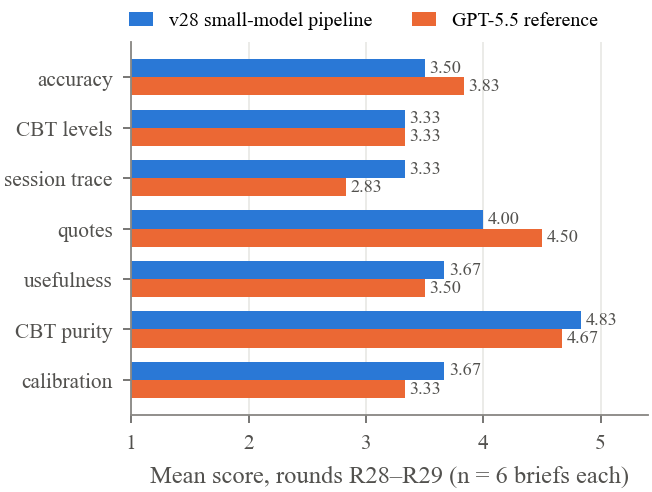
In the final rounds the best small-model version and the reference scored 3.77 vs 3.87 (R28) and 3.77 vs 3.57 (R29). Across six same-round pairs the difference was −0.4, +0.2, −0.1, −0.5, +0.9, +0.2: mean +0.05, SD 0.49. Neither system reached the supervisor's target average of 4.0. By criterion, v28 was ahead on session trace and calibration, behind on accuracy (agreement with the gold reference) and quotes, and level on CBT levels.
Cost
One v28 brief costs about USD 0.03 in section writing and takes 2.5–3 minutes; a best-of-3 brief about USD 0.11. Processing a new session adds about USD 0.07, mostly the classifier pass over every sentence. At list prices the frontier reference brief costs about 19 times a single v28 brief. The entire project used USD 5.57 of small-model tokens.
What helped, and what did not
Three things helped: fixing defects in deterministic code that the supervisor found, a high reasoning-effort setting for the section writers (the highest setting cost more and scored lower), and moving the suggested agenda, the prediction bar and the most recent risk-related statement into code. Several plausible additions hurt: fusing three drafts, a code-imposed belief timeline, salience hints with a coverage-repair pass, and rubric-guided self-revision. Each of them added a generation step in which a small model can lose or distort information. Every change that removed work from the model, or selected among outputs without rewriting them, was safe.
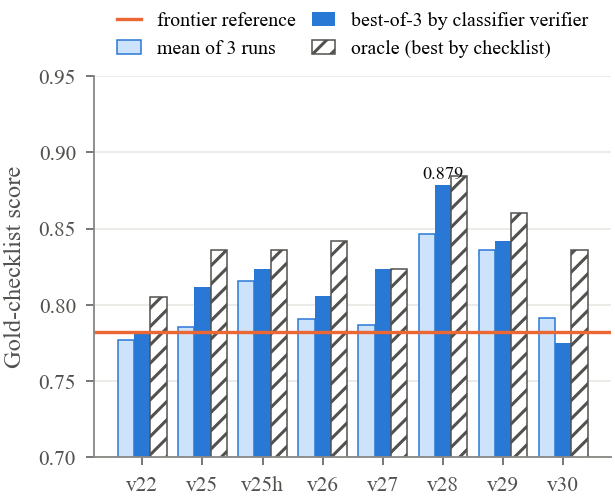
Verifier selection improved the checklist score for seven of eight versions; for v28 from 0.846 to 0.879, close to the oracle (0.885). Because the verifier and the checklist grader are the same classifier, part of this gain may reflect shared preferences.
What stayed hard
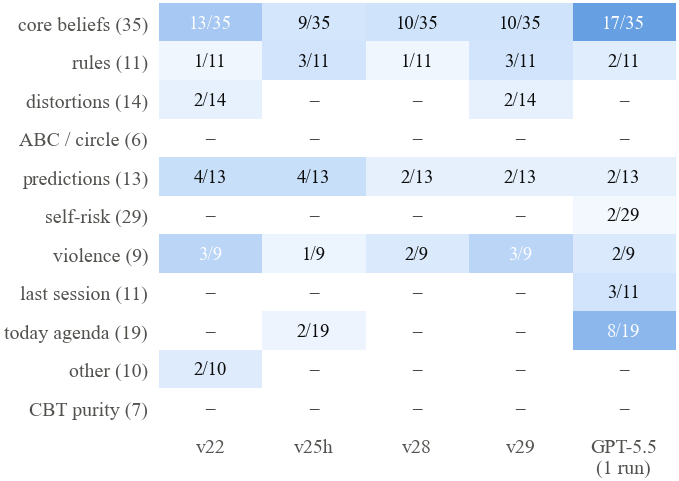
Persistent failures fell from 25 to 15 of 164 weight units between v22 and v28. What remains are the subtlest judgments of the cognitive model: the state of a belief after it is reactivated, belief ranges that stop before the latest material, and scope qualifications. Lines about risk were the hardest component: both missing a recent statement and turning a metaphor, an exercise or an emotion rating into a signal were penalised. The best design kept only the most recent literal statement and the session in which the therapist last asked about it directly, and left every interpretation to the therapist.
The judge is part of the experiment
Because the reference brief never changed, its scores measure the supervisor alone.
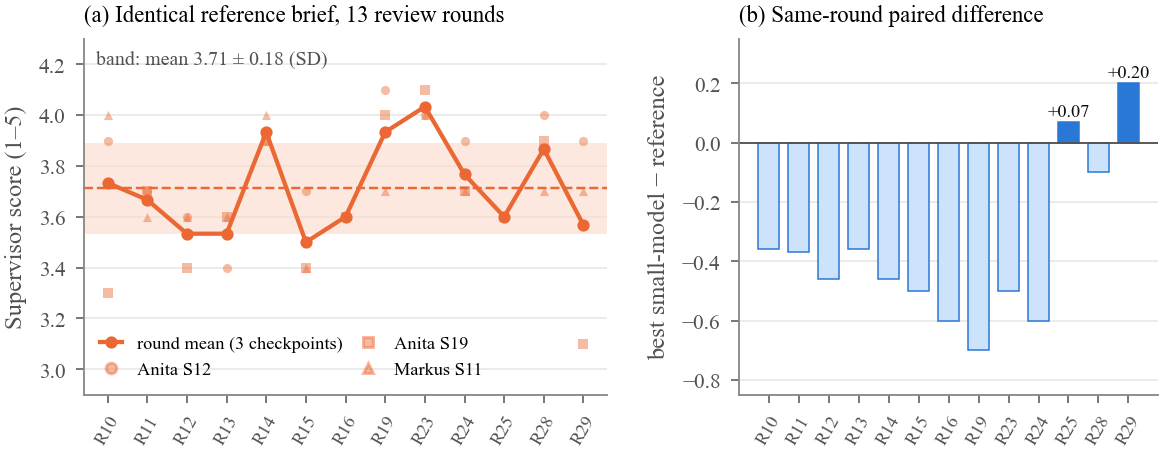
Across 13 rounds the identical reference brief received a round mean of 3.71 with SD 0.18 and a range of 3.50–4.03 on a 1–5 scale. On single criteria the SD reached 0.46, including for quotes that were script-verified and identical every time. That noise is about as large as the whole improvement the loop produced on the same scale.
What this study does not show
- Synthetic data only. Two synthetic patients, three checkpoints, three runs per version. Descriptive statistics only, no significance tests. Transfer to other tasks and to real material is argued, not shown.
- Model-based evaluation only. No clinicians or other human raters took part, by design. Scores describe agreement with a gold checklist and an LLM supervisor's judgment, not clinical quality, safety or any effect on therapy.
- Tuned on the evaluation set. All versions were developed against the same checkpoints and judges, so final scores are optimistic. A held-out patient would be the proper test.
- Indistinguishable is not better. In blind review the small model and the frontier reference could not be told apart at this sample size; the differences lie within the judge's own noise.
- Shared classifier. The checklist grader, the sentence scanner and the verifier are the same model.
- A modest reference. The frontier reference is one earlier, unoptimised pipeline run once with GPT-5.5, not a frontier pipeline tuned with the same loop.
Read the paper, check the numbers
The full paper is free to download. The data package with checklists, scores and example briefs comes by email.
The paper
Small Model, Careful Pipeline: An Autoresearch Method for Closing the Gap to Frontier LLMs on Long, Multi-Document Summarisation. Bartłomiej Głowacki, Joanna Głowacka, Bohdan Głowacki, Ewa Cylwik. AITHENTICA P.S.A. / Therapy Support, 2026. Preprint, 13 pages, 9 figures.
Download the data package
PDF of the paper, all nine figures, the three gold checklists, checklist and verifier scores for every version, blind reviews from the final rounds with their letter keys, and three final example briefs. A README explains every field.
We do not share addresses. The data link arrives within a few minutes.
What is in the ZIP
paper/: the paper as PDFfigures/: nine figures plus the numbers behind themscores/gold_checklists.json: 3 × 25 weighted statementsscores/checklist_results.json: per-item probabilities for 198 graded briefsscores/blind_review_R28.json,R29: seven criteria, verdicts and objections, with letter keysexample-briefs/: three final v28 briefs (in Polish, like the transcripts)
Not included: synthetic transcripts, prompts and code. They are available from the authors on request for research use.
How to cite
@misc{glowacki2026smallmodel,
  title  = {Small Model, Careful Pipeline: An Autoresearch Method for Closing the Gap to Frontier LLMs on Long, Multi-Document Summarisation},
  author = {G{\l}owacki, Bart{\l}omiej and G{\l}owacka, Joanna and G{\l}owacki, Bohdan and Cylwik, Ewa},
  year   = {2026},
  note   = {Preprint, AITHENTICA P.S.A. / Therapy Support},
  url    = {https://aitherapy.support/research/small-model-careful-pipeline/}
}