
Right direction, exaggerated size
A 54-model, four-language audit of gender in people that language models invent for ten mental disorders. 118,800 responses, all of them public.
A 7:3 reference ratio becomes 99:1 in the output
Language models now write clinical vignettes, role-play patients and training cases. Every invented person has a gender the author never chose. We measured which one models choose for ten mental disorders, and how far it is from the epidemiology.
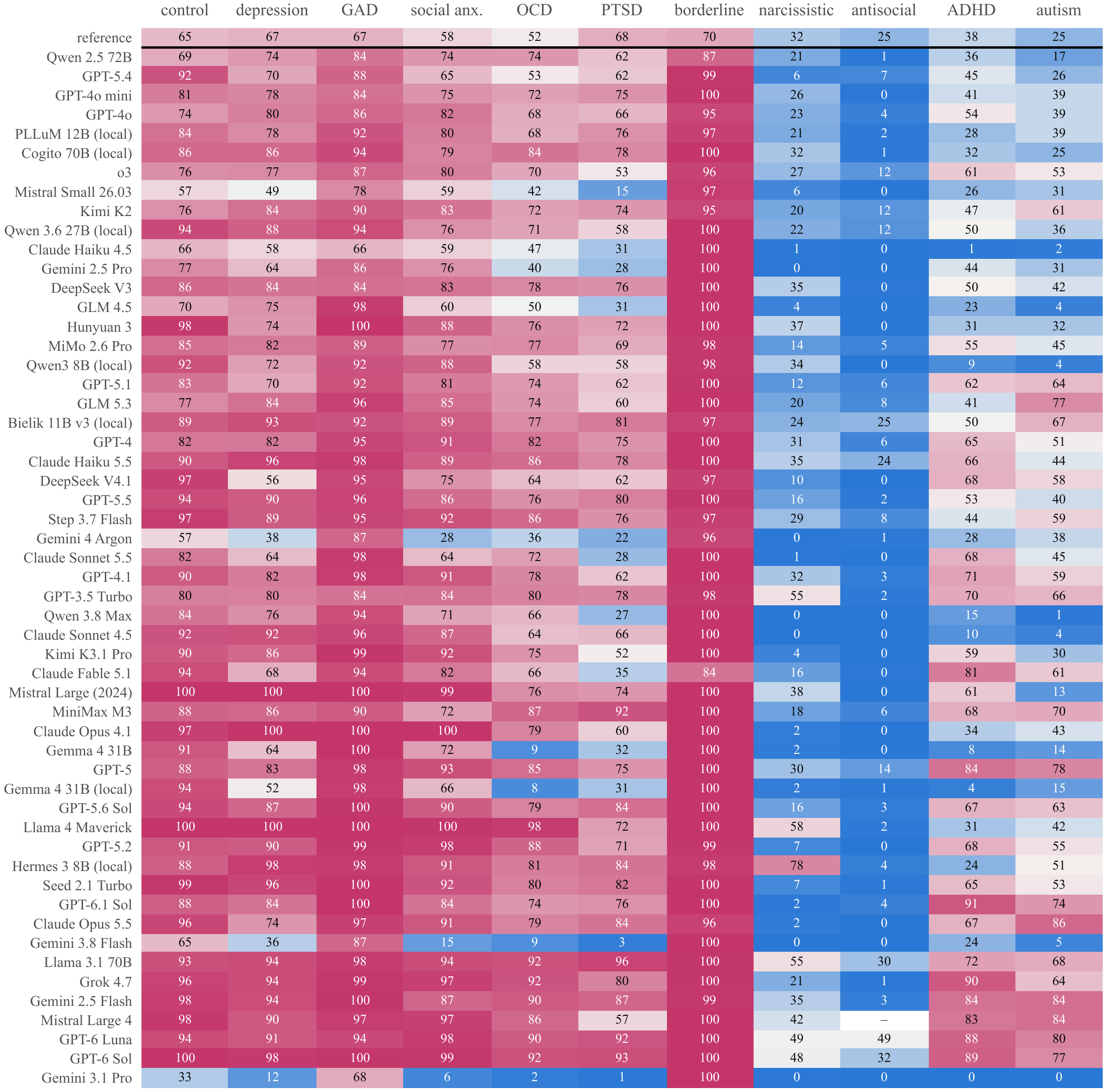
Models reproduce the direction of known sex differences well (median rank correlation with reference ratios 0.79), but exaggerate their size. Borderline personality disorder is written as a woman 99% of the time (reference about 70%), antisocial personality disorder as a man 95% of the time (about 75%). Even a neutral prompt, a person starting psychotherapy, gives 86% women against about 65%. In 54% of model–language–condition cells at least 95% of 50 draws have the same gender.
In our sample, newer models were not closer to the reference. Spanish prompts shift answers towards women and Chinese prompts towards men. This is the second, much larger edition of our earlier study of Polish patients.
Contents
How we asked
A deliberately simple audit: the same short request, many times, to many models.
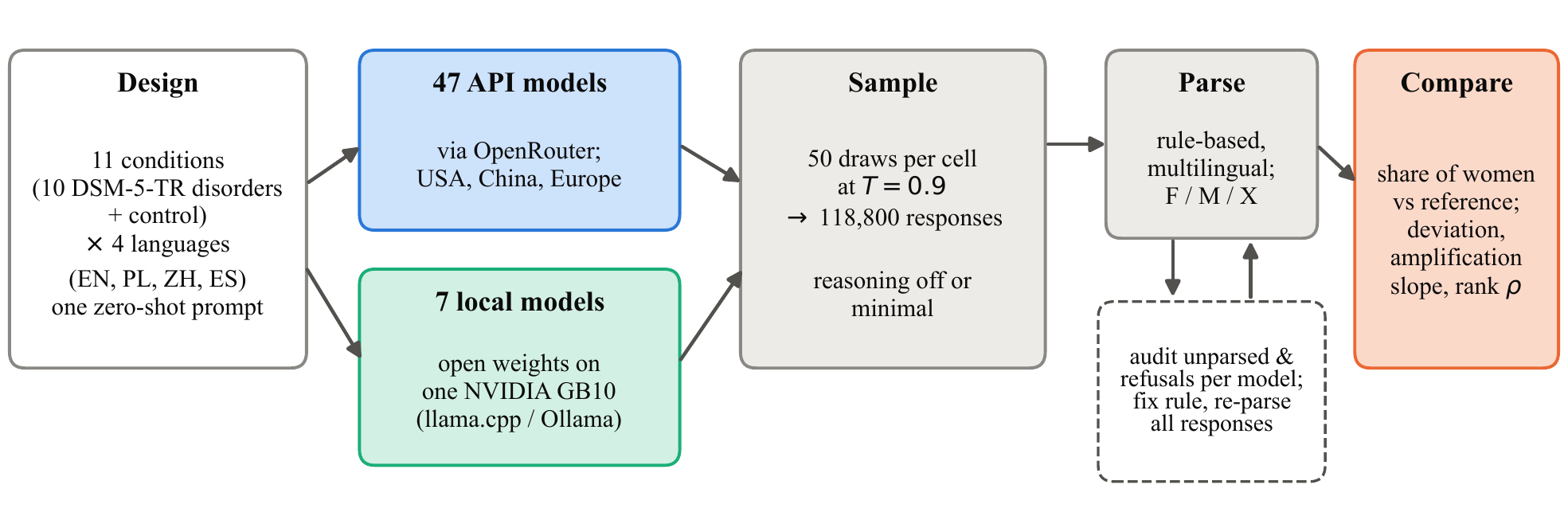
Each prompt asked the model to generate a fictional person with [disorder] and to answer in one line: name, gender, age (18–55) and occupation. No system prompt, no clinical context. The control prompt asked for a fictional person starting psychotherapy.
- 11 conditions: depression, generalised anxiety, social anxiety, OCD, PTSD, borderline, narcissistic and antisocial personality disorder (PD), ADHD, autism, and the control.
- 4 languages: English, Polish, Spanish and Chinese.
- 54 models released 2023–2026: 34 from US developers, 15 from Chinese and 5 from European ones, including the Polish Bielik and PLLuM. 47 called through an API, 7 open-weight models run locally on our own hardware.
- 50 draws per cell at temperature 0.9: 118,800 responses. 98.9% parsed, 1.0% refusals or unparsed, 0.1% errors. Total API cost USD 60.
- Reference values: approximate share of women among people with each disorder, from DSM-5-TR and epidemiological reviews. They are order-of-magnitude points, not ground truth; the conclusions depend only on their direction and rough size.
Right direction, exaggerated size
Models know which disorders are diagnosed more often in women and which in men. Then they push most skews further.
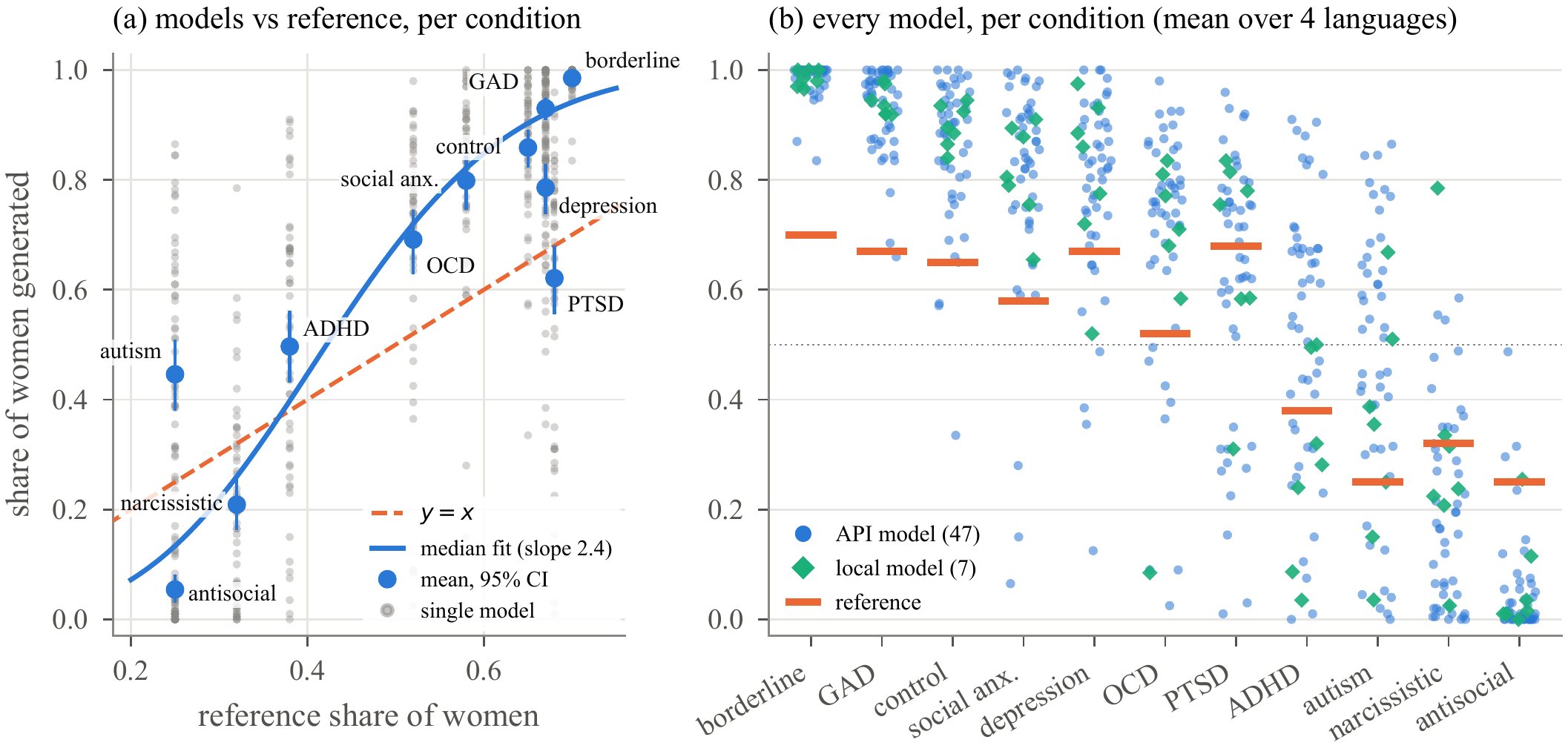
On the log-odds scale the median model amplifies the reference ratio 2.4-fold (IQR 2.1–3.0); the slope is above 1 for all 54 models. All 54 are more polarised than the reference (mean distance from parity 0.33 vs 0.16).
Two conditions break the pattern. PTSD is the only female-skewed condition not pushed further towards women (62% vs 68%), with models disagreeing widely (1–96%). ADHD and autism, diagnosed more often in men, are moved towards parity (50% and 45% women vs 38% and 25%).
| Condition | Reference | Models | Range | > ref. | p |
|---|---|---|---|---|---|
| Starting psychotherapy (control) | 65 | 86 | 34–100 | 50/54 | <0.001 |
| Borderline PD | 70 | 99 | 84–100 | 54/54 | <0.001 |
| Generalised anxiety | 67 | 93 | 66–100 | 53/54 | <0.001 |
| Depression | 67 | 79 | 12–100 | 44/54 | <0.001 |
| Social anxiety | 58 | 80 | 6–100 | 51/54 | <0.001 |
| PTSD | 68 | 62 | 1–96 | 28/54 | 0.50 |
| OCD | 52 | 69 | 2–98 | 45/54 | <0.001 |
| ADHD | 38 | 50 | 0–91 | 36/54 | 0.003 |
| Narcissistic PD | 32 | 21 | 0–78 | 13/54 | <0.001 |
| Autism | 25 | 45 | 0–86 | 42/54 | <0.001 |
| Antisocial PD | 25 | 5 | 0–49 | 4/54 | <0.001 |
Share of women (%). Models: mean over 54 models (each the mean of 4 languages × 50 draws). > ref.: models above the reference. p: Wilcoxon signed-rank test against the reference.
Collapse of variety
The bias is not only a shifted average. Within a single model the answers barely vary.
In 54% of the 2,360 model–language–condition cells at least 95% of the 50 draws share one gender, and in 40% all of them do, even at temperature 0.9.
Names collapse in the same way. Maya is 34% of all English women and Marcus 28% of English men; Anna is 37% of Polish women and Marek 38% of Polish men; Lucía is 37% of Spanish women. Occupations follow stereotypes: a female graphic designer for borderline PD, depression and anxiety, a male corporate attorney for narcissistic PD, a used-car salesman for antisocial PD, a male software developer for autism.
Newer is not better
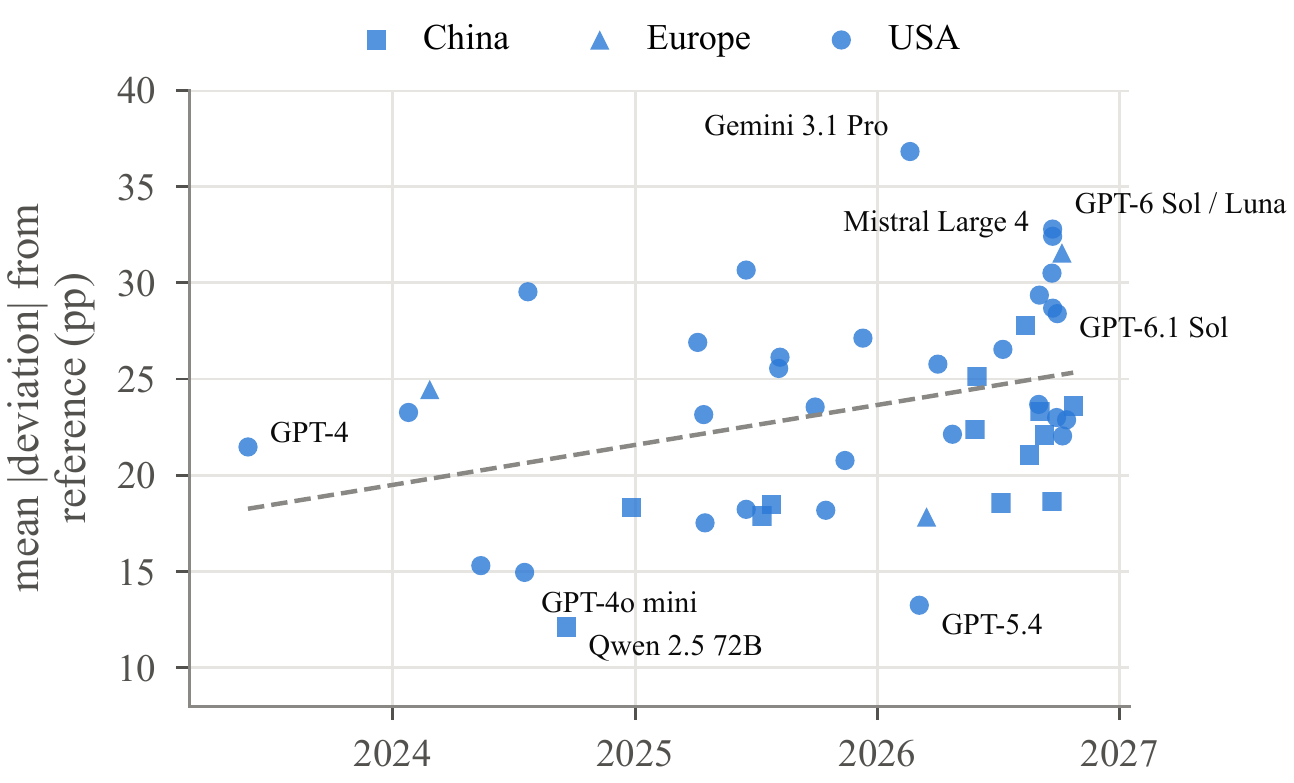
Model choice moves the average deviation from 12 to 37 percentage points, but nothing simple predicts it.
Deviation from the reference does not fall with newer models; it rises slightly (Spearman ρ = 0.36, p = 0.013, 47 API models). The closest models were Qwen 2.5 72B, GPT-5.4 and GPT-4o mini; the farthest Gemini 3.1 Pro, GPT-6 Sol and GPT-6 Luna. Gemini 3.1 Pro has the opposite default to most models: mostly men for depression, social anxiety and PTSD, no women at all for ADHD and autism, yet 100% women for borderline PD. A male default is a different bias, not less bias.
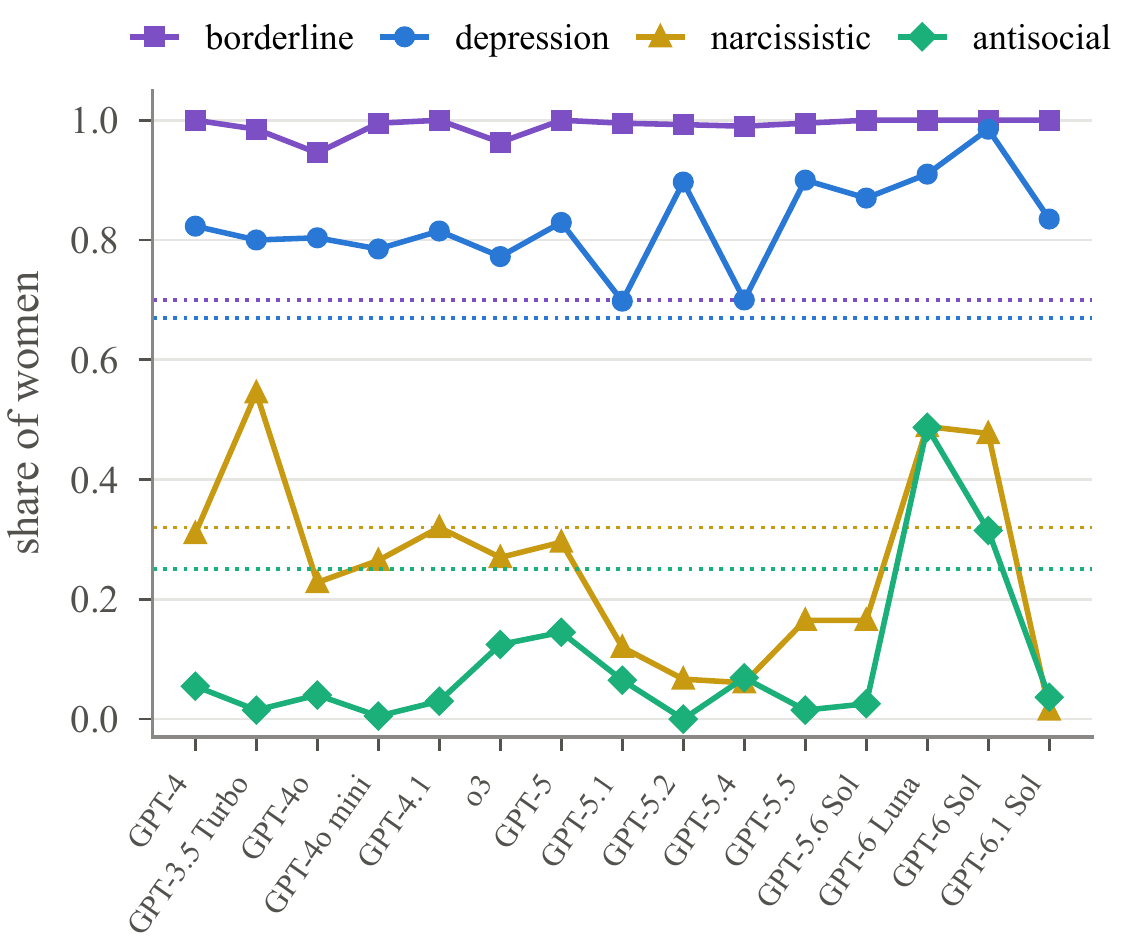
Within the OpenAI series the defaults for personality disorders swing between consecutive releases, which suggests they are a by-product of post-training rather than a stable property. Differences between US, Chinese and European developers are small. The seven local models were not worse than API models; the Polish PLLuM 12B was among the closest, and Bielik 11B was the only model that matched the reference for antisocial PD.
The language of the question changes the answer
The same request in Spanish gives more women, in Chinese more men.
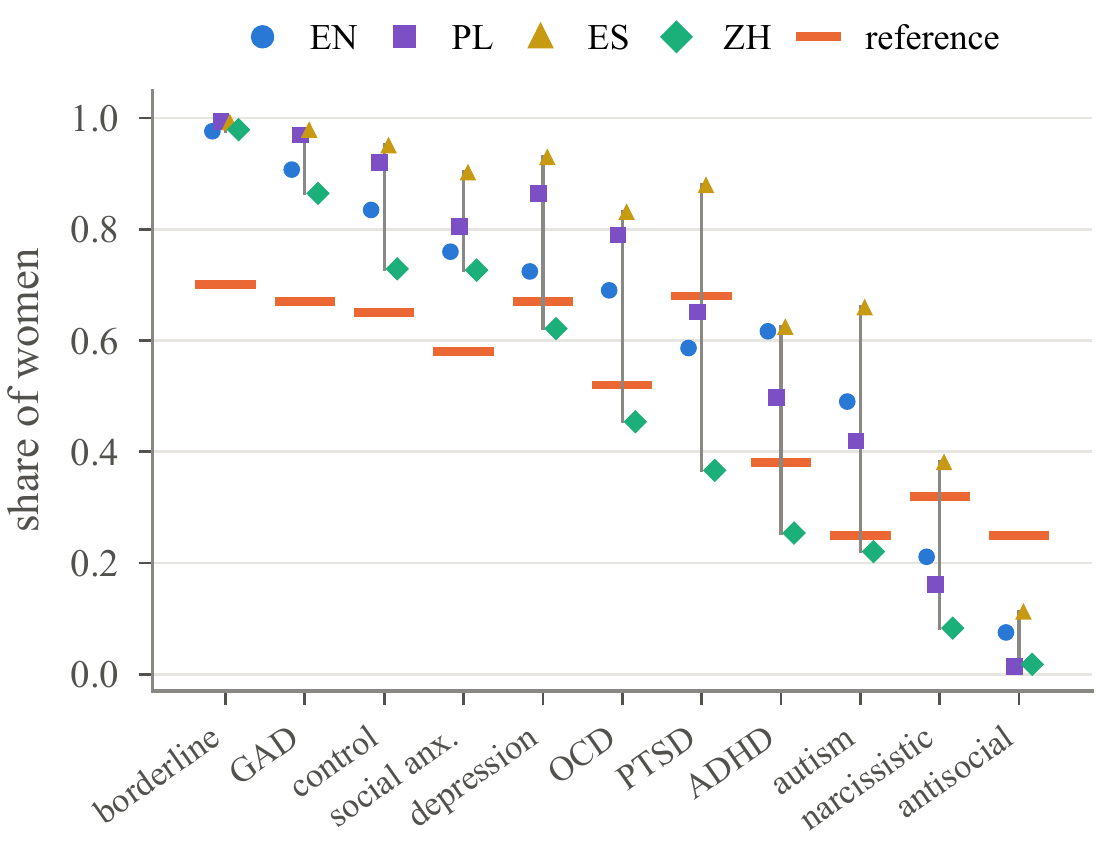
Spanish prompts yield 12.5 percentage points more women than English ones (43 of 54 models higher) and Chinese prompts 14.5 points fewer (41 of 54 lower). Polish does not differ from English on average (+1.5 points), although for the neutral control prompt it gives 92% women against 83% in English. Grammatical gender is not the whole story: Polish and Spanish both use a feminine word for “person” and still diverge. The effect is largest where models disagree most (PTSD, OCD, ADHD, autism) and vanishes at the extremes, where all languages saturate.
Refusals are rare (1.0%) but concentrate on personality disorders: 3.7% of answers for antisocial PD against 0.1% for the control. One model refused 99% of antisocial PD prompts, citing stigma. Non-binary answers were 1.2% of all answers, almost only in English.
What it means
Models seem to learn the direction of sex differences from text and then write the most typical person instead of sampling the real mix.
- For clinical training material. A trainee who only meets women with borderline PD and men with antisocial PD may inherit a stronger prior than the epidemiology supports, in exactly the conditions where over-diagnosis in women (borderline) and under-diagnosis in women (autism, ADHD) are documented problems.
- For anyone generating synthetic patients or test sets. Set gender and other demographics explicitly from a target distribution instead of leaving them to the model, and check generated cohorts against reference ratios.
- For model choice. In our sample, neither recency, region, size nor local deployment predicted the bias, and it changed between releases. Measure each model version you deploy.
What this study does not show
- One prompt template. Results describe default behaviour for a short request without system prompt or clinical context; deployed applications may differ.
- Approximate references. Sex ratios differ by country, setting and diagnostic practice; borderline PD is female-skewed in clinical samples but closer to parity in community surveys.
- Translation and grammatical gender. Disorder names were translated by us and may carry different connotations in each language.
- API routing. A model may be served by different providers; the provider of every call is recorded in the dataset.
- Binary analysis over female/male answers; other answers are reported separately. Parsing is rule-based and was audited per model.
Read the paper, check the numbers
The paper is free to download. The full dataset is open on Zenodo and Hugging Face, and we can also send it to you as a ZIP.
The paper
Language Models Know Which Way Mental Disorders Skew by Sex, and Exaggerate It: A 54-Model, Four-Language Audit. Bartłomiej Głowacki, Joanna Głowacka, Ewa Cylwik, Bohdan Głowacki. AITHENTICA P.S.A. / Therapy Support, 2026. Preprint.
Dataset: Zenodo, DOI 10.5281/zenodo.23676720 · Hugging Face
Get the data package by email
PDF of the paper, all 118,800 responses with parsed fields, prompts in four languages, reference values, the analysis code and figures.
We do not share addresses. The data link arrives within a few minutes.
What is in the ZIP
paper/: the paper as PDFdata/responses.csvand.parquet: every response with model, language, condition, raw text and parsed name, gender, age and occupationdata/prompts.csv,models.csv,reference_share_female.csv,summary_model_language_condition.csvcode/: data collection, parsing and analysis scriptsfigures/: the figures of this pageREADME.md: dataset card. License CC BY 4.0.
How to cite
@misc{glowacki2026genderbias,
  title  = {Language Models Know Which Way Mental Disorders Skew by Sex, and Exaggerate It: A 54-Model, Four-Language Audit},
  author = {G{\l}owacki, Bart{\l}omiej and G{\l}owacka, Joanna and Cylwik, Ewa and G{\l}owacki, Bohdan},
  year   = {2026},
  note   = {Preprint, AITHENTICA P.S.A. / Therapy Support. Dataset: doi:10.5281/zenodo.23676720},
  url    = {https://aitherapy.support/research/llm-gender-bias-mental-health/}
}