
More than session transcription
Clarity
in clinical thinking
A platform for CBT and schema therapy practitioners
Therapy Support organizes what your thinking about the case rests on - the conceptualization, the working hypotheses, the continuity between sessions. So the documentation keeps up with your work, instead of your work keeping up with the documentation.
Built around CBT and schema therapy. Compliant with GDPR and the EU AI Act.
Trusted By


The Invisible Work
Documentation, archiving, session planning, supervision preparation, conceptualization, billing, SMS to patients — all of this takes time.
100
sessions per month
20
minutes of invisible work per session
20
hours monthly on administration
But the real cost is not the hours. It is the threads that get lost between sessions, the hypotheses that do not come back in time, and the continuity of the process that dissolves into paperwork. We give that time back - and we look after what gets lost inside it.
Most AI tools transcribe what was said.
Therapy Support surfaces what is clinically relevant - not just the words.
The platform is built on the conceptual structure of CBT and schema therapy. It assumes a session is one moment in a longer process - and it keeps that process continuous between sessions.
Case conceptualization
A living document the platform updates alongside you; not a form filled in once after the intake interview.
Working hypotheses
Tracked between sessions and refined with each one - not lost somewhere between notes.
Cognitive distortions
Proposed from the content of the session - with timestamps, for you to verify, at hand while you work on the conceptualization.
ABC analysis
Activating event (A) - belief (B) - consequence (C) threads carried coherently through the whole therapy, not in fragments session by session.
Continuity between sessions
A view of “this patient across eight sessions” - what changed, what held, what surprised you.
Modes and schemas
For those working in schema therapy: a mode map, schemas and coping styles proposed as hypotheses for you to accept or reject, not as a classification of the patient. Coming soon.
What it looks like in practice
Four moments where the platform actually helps.
After the session
You click “generate note” and 30 seconds later you have a structured clinical note: the agenda, the homework you went through, the interventions that were picked out, a summary. Two edits, save - done in 2-3 minutes.
Between sessions
Material from successive meetings comes together into a coherent picture of the process. The catastrophizing thread from sessions 3 and 7, the PHQ-9 score from two weeks and from two months ago - in one view.
During the process
The conceptualization updates with every session. In session 6 the patient mentions their father for the first time - you add a hypothesis, and it sits alongside the elements of the model you already have.
Before a session or supervision
8:55, five minutes to the session. You open the patient record and in 30 seconds you have the homework, the morning questionnaire score and the thread from session 3. You walk into the session with context.
The note comes out of working on the case -
it is not a separate task.
That is why the platform starts from the conceptualization and the structure of the process, and finished documentation is the natural result.
Conceptualization
You see the structure of the case before you start drawing it yourself. One click gives you a proposed cognitive diagram, vicious cycle model, ABC analysis or problem map - based on the material from the session. You compare it with your own understanding of the patient, add to it, question it, update it. The application proposes. You decide on the direction.
- →CBT cognitive diagram generated from the content of the session
- →Vicious cycle model and ABC analysis in one click
- →Export to PDF
- →The diagram updates as sessions go on
Structure based on the CBT process
You do not have to invent your own documentation format. The application divides the work with the patient into the areas you know from your training. Data from each session lands in its place - you fill the structure with clinical content.
- →Initial consultation and intake interview
- →Clinical situations and automatic thoughts
- →Cognitive distortions and ABC analysis
- →Therapy goals and case conceptualization
Smart clinical note
Less than 30 seconds after the session you have a ready note structure to verify and complete. Instead of reconstructing the conversation from memory, you work with material that is already organized.
- →Real-time speaker recognition
- →Interventions and key clinical content picked out
- →Note ready in under 30 seconds
- →Review and edit after the session
Overviews
The whole course of therapy in one view. No digging through archives, notebooks and files. The picture of each therapy stays readable, even when you are seeing several patients in parallel.
- →Notes compared across sessions
- →Questionnaire scores over time
- →The dynamics of the process from the first to the last visit
- →Therapy goals and how they evolve, kept visible
Preparation for supervision
Ready material instead of a chaos of notes. You come to supervision with the context of the whole process, not just the material from the last session.
- →Key moments of the therapy extracted automatically
- →Working hypotheses and conceptualization in one place
- →A chronology of the process and of the changes in the patient
- →The consequences of successive interventions visible over time
Practice management
Running the practice calmly, with fewer tasks between sessions. Calendar, payments and reminders in one place - so administration does not eat the time that belongs to clinical work.
- →Integration with Google Calendar and Apple Calendar
- →Automatic SMS reminders that cut down cancellations
- →Payments and invoices in one place
- →Tools that support deliberate planning of your work
Security at every stage
Encryption in transit and at rest, column-level encryption of therapeutic data (Always Encrypted), full compliance with GDPR and the EU AI Act. Data stored in the European Union (Azure).
- →TLS 1.3 in transport, AES-256 at rest
- →Data pseudonymized before it is sent to the AI
- →Data stored in the EU; selected sub-processors (e.g. Stripe) may process data outside the EEA under standard contractual clauses
- →No AI model training on your data - contractually guaranteed
Schema therapy
For therapists working in schema therapy: schema and mode activation threads organized across the course of therapy - as hypotheses for you to verify, consistent with the CBT conceptualization.
- →Modes and schemas proposed from the session material
- →Activation threads tracked over time
- →Hypotheses for you to verify
- →Consistent with the CBT conceptualization
The AI proposes. The therapist decides.
This is not a marketing slogan - it is a design principle. The platform is built so that clinical judgment stays where it belongs - with you - while the AI takes on what used to eat your evenings: organizing the material, holding continuity and surfacing what matters.
What the AI does
- ✓Organizes the session material into the structure CBT actually uses
- ✓Holds the context between sessions, so you do not have to reread every previous note
- ✓Suggests hypotheses, distortions and thematic threads for you to consider
- ✓Drafts documentation close to your own style, ready for review
What the AI does not do
- ✗It does not make clinical decisions or recommend interventions
- ✗It does not replace supervision, peer supervision or your judgment
- ✗It does not diagnose and it does not assess risk
- ✗It does not finalize notes - nothing enters the documentation without your review
“Evidence-based”
we take literally.
CBT stands on evidence. We build the platform that supports it the same way - with research methodology, formal evaluation and scientific review from the start.
Pilot with the Institute of Psychology, Polish Academy of Sciences
A twelve-month pilot study with the Institute of Psychology of the Polish Academy of Sciences. Results expected at the end of 2026. Designed and reviewed under academic supervision.
EABCT and PTTPB conferences
We have submitted talks to EABCT (Brussels) and PTTPB (Katowice). The platform is being built inside the scientific CBT community, not on its margins.
Law and data protection
Our privacy policy and terms of service were reviewed by Aleksandra Maciejewicz (lawmore.pl) - a specialist in technology law and medical data in the EU.
Built by clinicians and engineers
Therapy Support is being built by a team that combines clinical CBT experience with experience of building software at scale.
What Do Therapists Need?
We listened to the needs of mental health professionals and created a solution that addresses the real challenges of daily practice.
“It writes phenomenal notes for me. It's a hit.”
Agnieszka
CBT Psychotherapist
“For me it was a total game changer.”
Marta
CBT Therapist (insomnia)
“What you're doing is brilliant — these transcriptions.”
Gosia
Psychologist, Netherlands
A platform that knows
who it was not built for.
We narrowed the scope on purpose. That makes the product better for the therapists we build it for - and saves time for those it would not suit anyway.
Who it is for
- ✓Psychologists and psychotherapists working in CBT
- ✓Schema therapists (ISST-certified or in training)
- ✓Private practices and small teams
- ✓Clinicians who care about the structure of their own thinking, not just the structure of their notes
Who it is not for
- ✗Psychiatrists working mainly in pharmacotherapy
- ✗Therapists working outside the CBT / schema therapy frame (e.g. purely psychodynamic)
- ✗Hospitals or large EHR systems - this is not enterprise software
- ✗Anyone looking for “an AI that runs the session” - the AI does not run sessions
Frequently Asked Questions
How is this different from an ordinary transcription tool?
A transcription tool turns a recording into text and its work ends there. Therapy Support starts where transcription ends: it arranges the material into the conceptual structure of CBT, carries the conceptualization and the working hypotheses between sessions, and looks after the continuity of the whole process. For us transcription is the starting point, not the finished product.
What is Therapy Support?
Therapy Support is a platform designed for therapists working in the CBT approach. It combines clinical documentation, case conceptualization, practice management, and supervision preparation in one place - with responsible AI support.
Who is the platform for?
For psychotherapists and psychologists working in the cognitive-behavioral (CBT) approach. The platform reflects the structure of the CBT therapeutic process - from initial consultation, through case conceptualization, to tracking progress over time.
How is Therapy Support different from general AI tools?
General AI tools analyze a single fragment of conversation, without the context of the entire therapy. Therapy Support works on data from the entire therapeutic process - it aggregates material from multiple sessions, allows identifying patterns over time, and maintains consistency between conceptualization and the course of therapy.
Do I have to work exclusively in the CBT approach to use the platform?
The platform is designed with the structure of cognitive-behavioral work in mind - conceptualization, ABC analysis, cognitive diagram, therapy goals. It also supports therapists working in schema therapy. If you work integratively but use CBT or schema therapy tools, the platform may be useful to you. The best way is to try it in practice.
What languages does the application support?
The application supports therapy sessions in multiple languages - transcription and notes are generated in the language in which the session is conducted. The platform interface is available in 26 languages.
Will AI replace the therapist?
No. AI in Therapy Support organizes clinical material, creates notes, and supports work structure. It does not make clinical decisions, does not interpret material, and does not conduct therapy. AI proposes - the therapist decides.
What exactly does AI do in the application?
AI processes a session transcription into a structured clinical note in less than 30 seconds. It distinguishes speakers, identifies interventions and clinical content. It supports generating conceptualizations (cognitive diagram, vicious cycle model, ABC analysis). Every AI output is available for review and editing - the therapist has full control.
Does AI learn from my patients' data?
No. AI operates in inference mode - it processes data at the moment of the query and does not remember it. Clinical data is not used for training models.
Can I edit what AI generates?
Yes. Every note, conceptualization, and summary generated by AI is available for editing. AI provides structure - the therapist verifies, corrects, and decides on the final form.
Is my patients' data safe?
Yes. Data transmission is encrypted (TLS 1.2+), data at rest is encrypted, and columns containing therapeutic content are additionally protected with Always Encrypted, with keys stored in Azure Key Vault. Only the therapist has access to session content. A small group of system administrators holds the technical permissions needed to maintain the platform and recover data; this access is logged and covered by confidentiality obligations. No patient personal data reaches the AI models — it is replaced with pseudonyms before sending, and the models run in the European Union and do not train on customer data.
Where is data stored?
Data is stored on Microsoft Azure servers in the European Union. Selected subprocessors (e.g. Stripe for payment processing) may process data outside the EEA under Standard Contractual Clauses.
Is the platform GDPR compliant?
Yes. The platform operates in full compliance with GDPR, AI Act, and ISO 27001 standard. Detailed information can be found in the Security section on the website.
Does the application work on mobile?
Yes. The mobile app is available on Android (Google Play Store) and iOS (App Store). It allows you to record sessions directly from your phone - useful when you work in different offices or locations.
Can I conduct online sessions through the application?
Yes. The application supports online video sessions - without the need for external tools. Recording and transcription work for both in-person and online sessions.
What is the patient portal?
The patient portal is a secure space where patients fill out questionnaires and therapy journals, check appointment dates, make payments, and receive materials between sessions. Questionnaire results and journal entries go directly to the therapist's application, supporting progress monitoring.
Can I transfer existing documentation to the application?
Currently, the application does not offer automatic import of existing documentation (e.g., notes from Word or other tools). New patients can be added immediately, and existing ones - gradually, starting from the next session. We are working on solutions to facilitate data migration.
Are there support materials in the application?
Yes. Every therapist has access to a toolkit - a set of materials useful in daily work. You'll find tips on how to talk to patients about session transcription, and other materials supporting work with the platform.
What are the subscription options?
You can find current plans and prices on the subscription page. We offer various plans tailored to the scale of your practice.
Can I test the platform before purchasing?
Yes. Therapists who complete an onboarding with us receive a 5-week trial period with full access to the platform. The onboarding is an individual online meeting — we set the platform up around the way you run therapy, so the trial goes into working with patients rather than learning the tool. Book an onboarding.
How can I change my plan or cancel my subscription?
Subscription management - plan changes, invoice data updates, cancellation - is available from account settings. Cancellation does not require contacting support. An invoice is automatically generated after each payment and available for download from your account.
How do I report a bug or problem?
Fill out the report form on our website. In your report, it's helpful to describe: what happened, when, and what should have happened. You'll receive an email confirmation with an estimated response time.
Is onboarding support available?
Yes. After registration, you receive tutorials for independent start-up and an invitation to an onboarding meeting - a short app demo tailored to your practice. The meeting is optional but recommended. Tutorials are also available in the Tutorials section on the website.
Can't find your answer?
Therapy, Practice, Technology
We write about what we're working on and why.

Scientific Articles
AI doesn't replace the therapist. It strengthens them.
Three recent studies on AI in cognitive-behavioral therapy speak with one voice: value appears where technology supports the clinician's decisions rather than taking them over.

Startup Life
Welcome Martyna Piwka to the Therapy Support team!
Martyna makes sure that working with Therapy Support is simple and valuable from day one — from onboarding to support in your daily work with the app.
Security
You don't trust AI in therapy? Good.
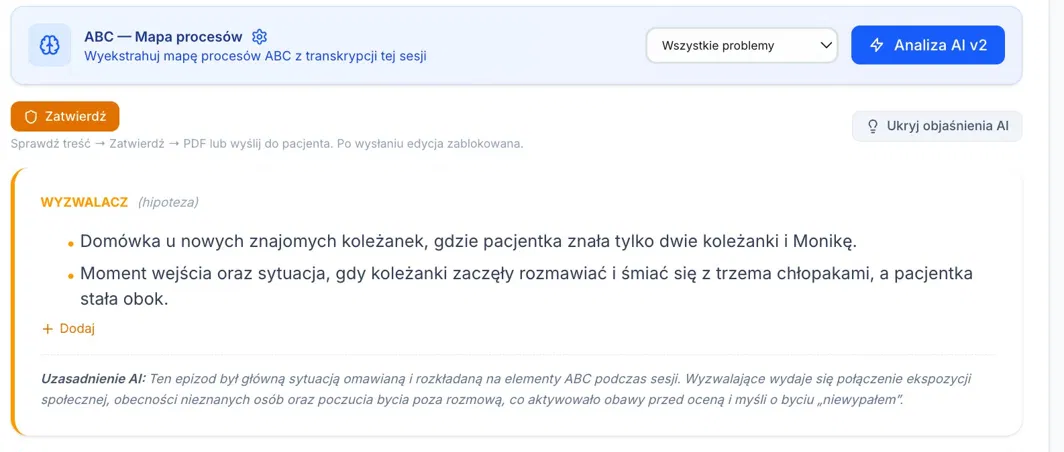
Skepticism toward AI in the consulting room is justified. Using a concrete example - a fragment of an ABC process map generated from a session transcript - we show why a tool earns trust not when it sounds confident, but when it stays honest: it shows its source, treats its conclusions as hypotheses, and openly admits what it does not know.
Therapy Support · Get started today
One coherent structure
for the whole therapy.
Are you a CBT therapist? See how the platform supports your everyday work: a conceptualization that grows with every session, working hypotheses that do not get lost, and notes that come out of working on the case.
Questions before you start? Write to kontakt@aitherapy.support.